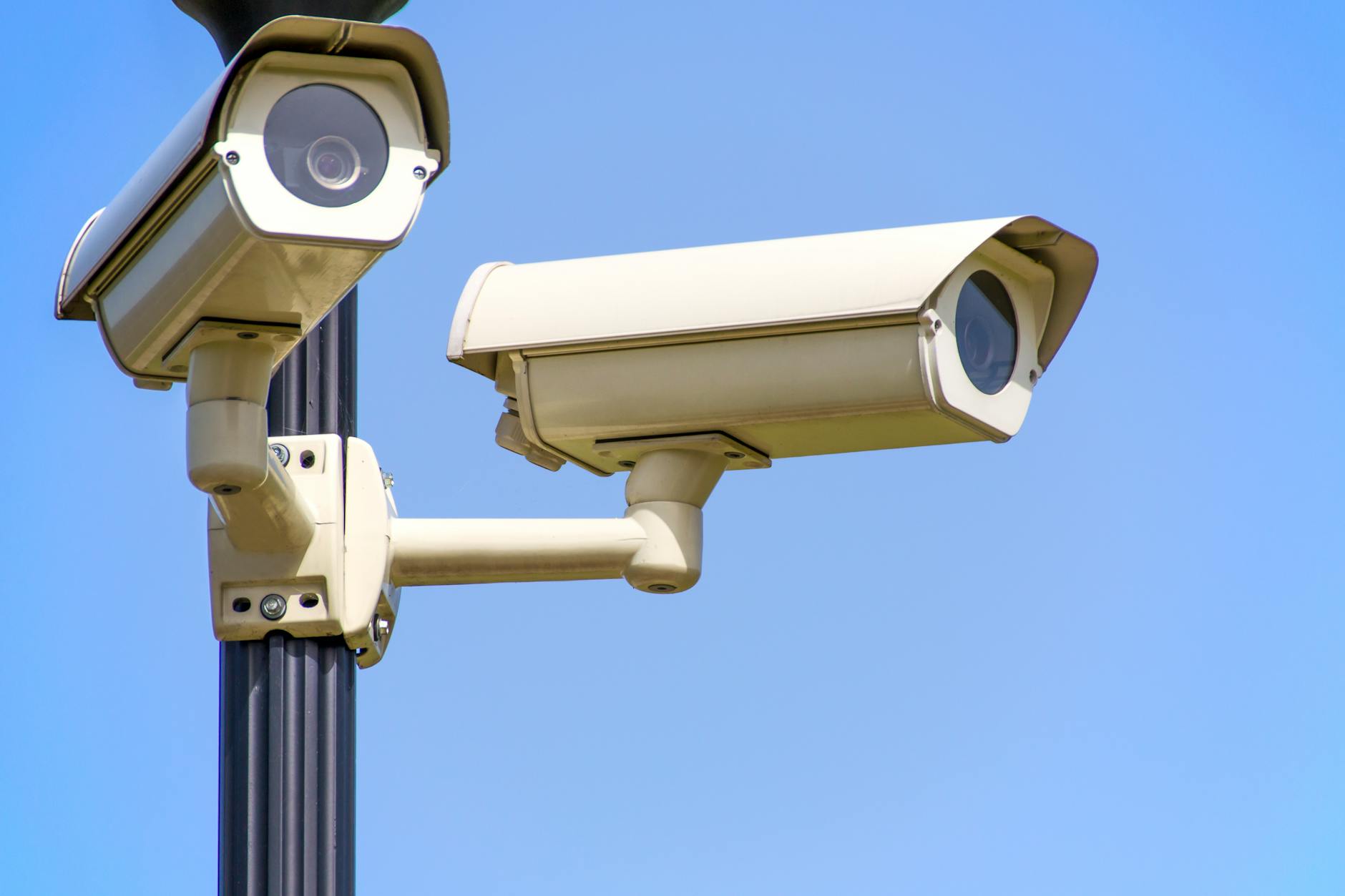
This photo, for me, seems to capture the theme of this issue of Media Fields Journal: surveillance.
In Scott Sundvall’s “The Rhetoric of Desiring-Surveillance: Diego Velázquez’s Las Meninas, Subjectivity, and Media(ted) Vision in the Age of Electracy,” the point is made that the trope of worrying about (or even being paranoid about) being watched all the time makes less and less sense in the digital age. He writes that he “slightly depart from recent scholarship in surveillance studies and argue that we first and foremost desire to see others and to be seen by others. I refer to this emergent frame of mind as desiring-surveillance”(Sundvall, 2016, p. 2). We have gone from orality to literacy to what Gregory Ulmer calls electracy. We live in the age of images and videos. Sundvall states that due to the many advanced technological changes in society, surveillance has become more lateral or horizontal. Rather than being concentrated in the hands of powerful corporations or governmental agencies, surveillance has become, if you will, democratized. The people themselves are able to record at a moment’s notice. If someone sees something funny or alarming, she can take out her cellphone and then post the video on social media. Moreover, every store, business, workplace, etc. has security cameras on the outside and on the inside. Sundvall also discusses Velázquez’s famous 1656 painting, Las Meninas—focusing on Foucault’s ekphrastic analysis and Bentham’s panoptic gaze. He relates this painting and the discussion around it to the birth of modern subjectivity. A subjectivity that holds on to a possibly outmoded attitude toward privacy is one that is not keeping up with the times. In our electrate age, the self has become a brand.
Mark Andrejevic’s “Surveillance, Desire, and the Obliteration of the Subject” tackles the subject of “how to approach the systemic horror of a totalizing monitoring apparatus” represented by surveillance. This article takes a more pessimistic view of surveillance than Sundvall’s. The argument that Andrejevic outlines in his Freudian/Lacanian piece is that, in thinking through surveillance, we should perhaps retire any notion of surveillance stuck “in sociocultural terms” and go “beyond the standard sociological approach that considers the role of surveillance in the disciplining and rendering productive of subjects” (Andrejevic, 2016, pp. 5-6). Desire, in this article, is reinterpreted as drive. Drive is “the form that desire takes when, in Lacanian terms, it misses its object and turns back upon itself,” potentially leading to the ultimate form of masochism: self-obliteration. The “predictive power” of total surveillance is bent on erasure. It is a power that that seeks to obliterate action, history, and subjectivity” (p. 6). For Andrejevic, “[t]he interactive and mutual character of social networks tends to dismantle the distinction between seeing and being seen, which facilitates both self-display and tracking (by “friends,” companies, and the state)” (p. 3). The desire to watch and the desire to be watched, as well as the desire to know and to be known represent two forces, or drives, that may wind up eating each other up, although Andrejevic doesn’t quite put it that way.
Sundvall’s point about the Paparazzi might be interesting to bring up here: “the paparazzi (as an electrate surveillance modality) might be resisted by celebrities, but the paparazzi also afford celebrity in the first place. First and foremost, vertical, top-down surveillance techniques are afforded by and even predicated on an ever-expanding, horizontal, brand-to-brand desiring-surveillance.” Unlike Andrejevic, Sundvall takes a more Deleuzian approach. “Drives” feel deterministic, but for Deleuze and Guattari “desire can never be deceived” and as “they note in Anti-Oedipus, the masses were never conned into fascism; they desired it” (Sundvall, 2016, pp. 11-12).
Simone Browne, in her article, ‘“Your Personal Information is Being Requested”: Ancestry Testing, Stunt Coding, and Synthetic DNA,” is concerned that genetic data used for surveillance purposes might not be such a good thing. Questions of consent and of regulation also come up for her and are in need of careful consideration. She makes the point that “[a]ncestry testing and police databases situated in disproportionately policed and disproportionately represented communities present us with spaces for questioning the expanded uses, or “surveillance creep,” of databasing DNA” (Browne, 2016, p. 4). Discussing a well-known personal genomics/ biotechnology company located on the West Coast, Browe writes that “23andMe provides its paying users the choice to share their genetic personal data and any intellectual property derived from such data to non-profit and commercial organizations” (p.3). This important data “is used for research purposes, including the formation of “disease communities” “to understand, through genetics, why people respond differently to disease treatment options and drugs.”’ [Here Browne is quoting from research made available on 23andMe’s Website.] The profit motive rears its head, and as we know from certain industries (usually Bid This and Big That), the peoples’ best interests are not exactly kept in mind: “Such personal genetic file-sharing is part of an increasingly interconnected system of knowledge about the human body collected in databases and used to track habits and movements, to profile, and to accumulate information for commercial applications” (p. 3).

 Digital WRTC