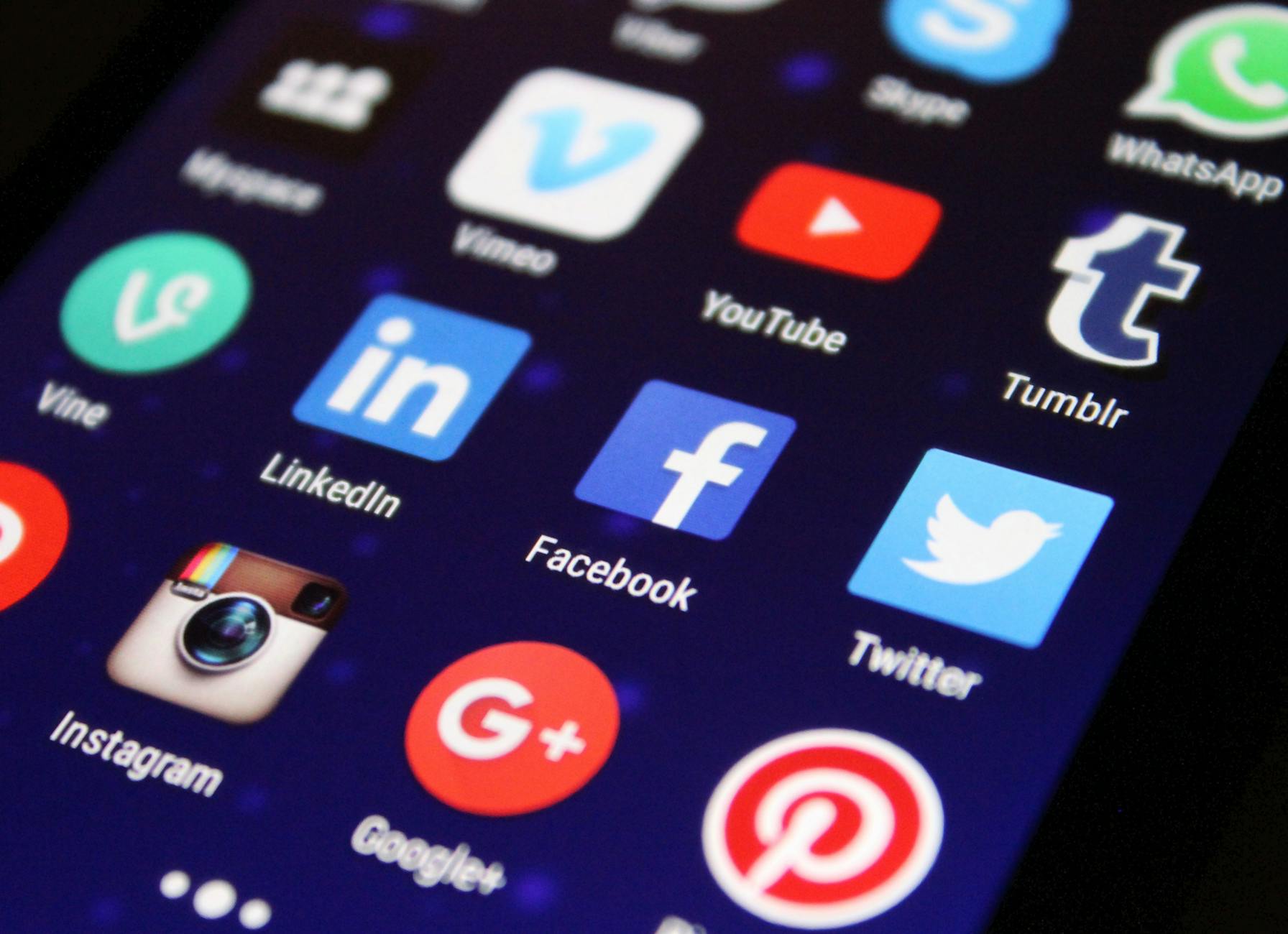
This photo, for me, represents the growing presence the digital plays in our lives. The phone, as an isolated object, is not emphasized. What we notice is the aesthetics of mobile app user interface design.
Brooke, in Lingua Fracta: Towards a Rhetoric of New Media (2009), uses his own terms for the five canons of classical rhetoric. Perspective is how Brooke denominates style. As always, Brooke’s focus is on interfaces and not “static texts” (p. 114). He quotes from Keith Moxey’s 1995 New Literary History article, “Perspective, Panofsky, and the Philosophy of History,” writing that perspective could describe “either one point of view among many, or the point which organizes and arranges all the others” (p. 114). As Douglas Eyman reminds us in his book, Digital Rhetoric: Theory, Method, Practice (2015), “For Aristotle, style was primarily a question of matching the appropriate forms of language to the discourse at hand, but he also had several suggestions for developing effective style (including an emphasis on correctness, use of appropriate metaphor, and an avoidance of excessively ornamental prose)” (p. 70). Eyman also writes—and this part helps to explain further Pixabay’s photo that heads this weblog post— “[s]tyle takes on new importance for digital rhetoric, particularly in terms of visual style: for a digital rhetoric, style is equivalent to “design”; thus, digital rhetoric must be concerned with understanding all the available elements of document design, including color, font choice, and layout, as well as multimedia design possibilities such as motion, interactivity, and appropriate use of media” (p. 70). Here “all the available elements of document design” reads a lot like Aristotle’s “all the available means of persuasion.” Brooke remarks that the field of rhetoric and composition studies, or what Derek Mueller calls RCWS, “has undergone a “turn” to the visual over the past five years or so,” adding that accompanying a fairly good amount of intellectual work on “the visual,” we have “several composition readers on the market that take the visual as their focus . . .” (p. 115). Here I am reminded of Mueller’s chapter on “turn-spotting” in Network Sense (2017).
Eyman, I should note, discusses Brooke in his book, commenting that “Collin Brooke (2009) undertakes a complete reconfiguration of the classical canons of rhetoric in [his book]. While others have focused on a specific canon (such as memory or delivery) and their application or rearticulation in the face of digital texts, thus far only Brooke has provided a comprehensive consideration of all of the canons, describing their complex inter-relationships as an ecology of practice . . .” (p. 62).
Speaking of memory and delivery, Brooke renames these canons “persistence” and “performance” respectively. While memory still holds importance in, say, public speaking, some compositionists (Edward P. J. Corbett, for example) hold that any requirement to memorize material has been obviated by written communication (see pp. 143-144). Here we have what Brooke calls ecologies of code and of culture (p. 147); that is, memory as storage and memory as history (p. 147). Regarding the latter, memory-as-history can take the form of books or of monuments—with monuments acting as perhaps a kind of visual rhetoric. In thinking of delivery as performance, I was reminded of the curious (and often comical) phenomenon of “influencers in the wild” videos on YouTube. Here you have voyeuristic videos of videos being made, complete with commentary about how silly these people look dancing (for example) in the middle of crowded boardwalks and in other very public places/spaces. Their delivery does indeed look ridiculous . . . when viewed from the quizzical spectator’s perspective. When one views the finished, polished product of the dancers themselves, however, those same silly people look pretty daring and cool.

 Digital WRTC